
 English
 Arab
Arab
 Deutsch
 Português
 China
China
As world leaders meet in New York for the 81st session of the United Nations General Assembly, one question sits beneath many of the debates on the future of multilateralism: are our international institutions and rules still equipped for the world they are now being asked to govern?
The question is not whether international law remains relevant. It clearly does. The more difficult question is whether the system can keep pace with the speed and complexity of change.
The theme of this year's General Assembly, “Restoring Trust, Managing Transformation: A United Nations That Delivers for All”, reflects this exact tension. The agenda includes peace and security, UN reform, development financing, climate change, human rights, artificial intelligence, and the changing international economic order. The President of the General Assembly, H.E. Dr. Khalilur Rahman, has himself described the session as taking place at a moment of profound challenges to multilateral cooperation and a widening trust deficit.
For developing countries, particularly in Africa, these are not abstract institutional questions. They directly affect access to finance, trade, technology, policy space, and representation in the institutions that make decisions affecting their economies.
The answer should not be to discard established rules. It is to make international governance more capable of reviewing, learning, and adapting while preserving legal certainty and accountability.
A System Under Pressure
International trade offers a useful illustration. The General Agreement on Tariffs and Trade (GATT) established core disciplines for trade in goods, while the General Agreement on Trade in Services (GATS) extended the multilateral framework to services. Together with the wider WTO agreements, they created a rules-based system that has provided considerable predictability to international commerce.
But the global economy of today is not the economy of the Uruguay Round. Digital commerce, artificial intelligence, data flows, climate-related trade measures, industrial subsidies, and geopolitical competition have changed the fundamental questions that governments are asking of the trading system.
The WTO's dispute settlement experience is highly instructive. The Appellate Body has been unable to hear appeals because of continuing vacancies, having been functionally paralysed since December 2019 due to blocked judicial appointments. WTO members have recognised the need to address the resulting challenges and have continued discussions on reform.
This is more than a mere institutional problem. Dispute settlement is part of what gives a rules-based system credibility. Rules must not only exist; states must have confidence that they can be interpreted, applied, and enforced through institutions that remain functional. The wider lesson is that international legal regimes cannot assume that yesterday's institutional arrangements will remain adequate indefinitely.
Climate Change Shows the Importance of Learning and Delivery
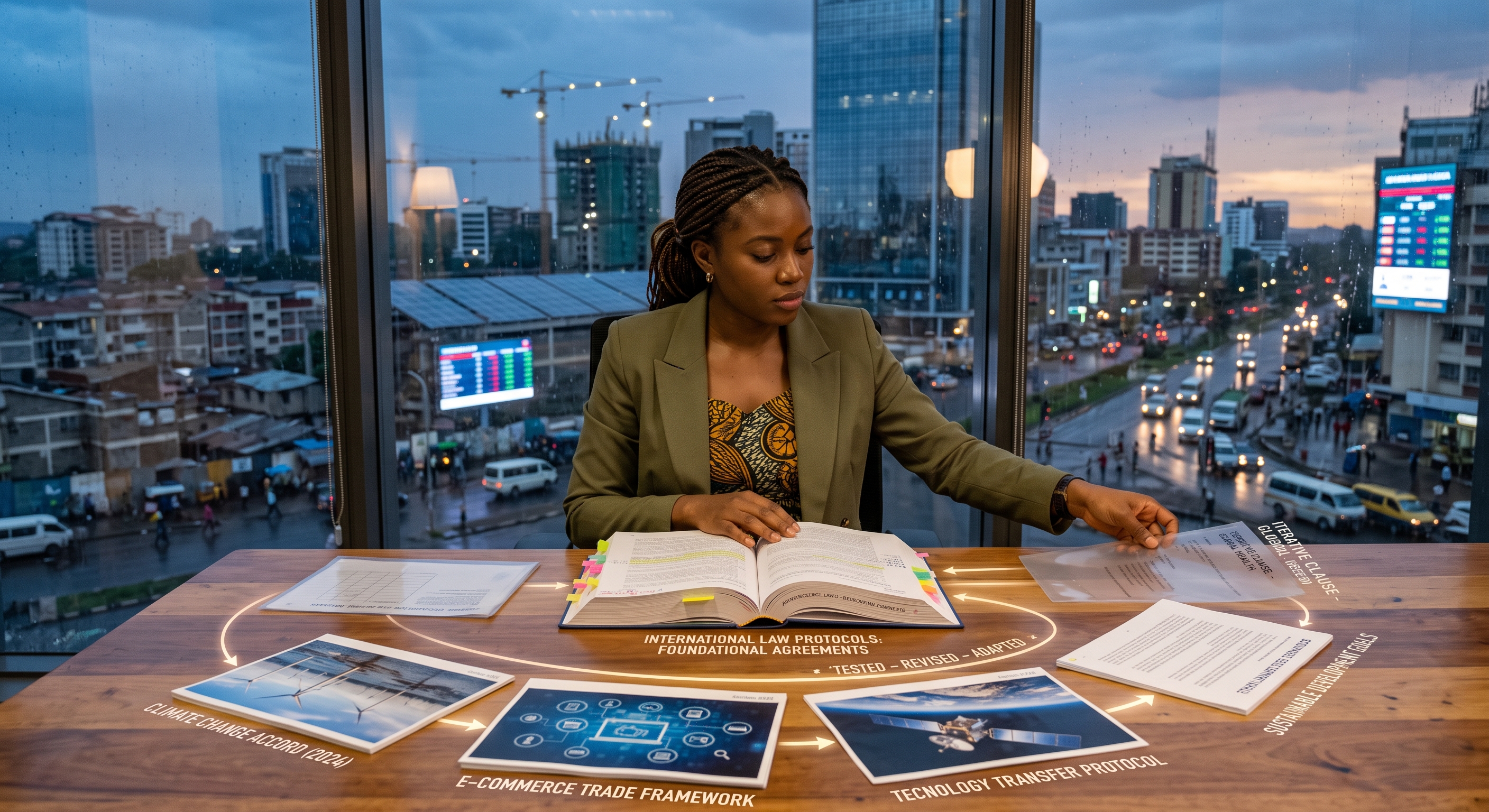
The climate regime provides a different example. The Paris Agreement does not depend on a single negotiation settling every aspect of climate policy. It incorporates cycles of national action, reporting, review, and the Global Stocktake, allowing parties to assess collective progress and adjust their efforts over time. That is, in essence, an iterative approach to international governance.
But climate change also exposes the limits of adaptation without implementation. Governments can agree on targets, reporting frameworks, and long-term commitments; the difficult question is whether those commitments are adequately financed and translated into action.
At COP29, countries agreed on a new climate-finance goal of at least $300 billion annually for developing countries by 2035, while calling for efforts to scale climate finance from public and private sources towards $1.3 trillion annually by 2035. The significance goes beyond the figures. It illustrates the point at which international law and policy meet economic reality. A commitment that cannot be financed or implemented will eventually become a source of frustration rather than trust.
The same applies to the Sustainable Development Goals. The question for multilateralism is increasingly not whether the international community can agree on another set of targets, but whether countries have the financing, institutional capacity, and policy space to deliver them. The real test is therefore the movement from policy to financing and from financing to implementation.
Africa Cannot Be a Rule-Taker in an Adaptive System
For Africa, reform also raises a critical question of voice. African states have consistently called for greater representation in global decision-making and reforms to an international financial architecture that does not adequately reflect the circumstances and financing needs of developing economies.
This matters because representation and implementation are closely connected. A country has less ability to shape international rules when it has limited negotiating capacity, technical expertise, or access to the resources required to implement what it has agreed.
An adaptive multilateral system must therefore allow developing countries to participate not only in negotiating rules but also in reviewing how those rules operate and determining how they should evolve. That requires targeted investment in African policy institutions, legal and technical expertise, data systems, and regional cooperation. Greater flexibility without greater capacity could simply produce a system in which the most technically and financially powerful states remain best placed to shape the next generation of international rules.
AI Is Testing the Speed of International Law
Artificial intelligence makes this problem particularly visible. AI technologies are developing on a timescale that conventional treaty-making was not designed for. It is structurally difficult to negotiate a detailed international legal regime around technologies whose capabilities and risks may change substantially before the negotiation is complete.
The Global Digital Compact, adopted by UN Member States in 2024, recognises this reality. It calls for international cooperation on AI that is “agile and adaptable” and provides for an Independent International Scientific Panel on AI alongside a global dialogue on AI governance. It also stresses the need for developing countries to build the capacity to participate in and benefit from AI governance.
There is an important legal principle here: adaptability should not mean abandoning established rights or standards. The Global Digital Compact itself places digital cooperation within the framework of international law and human rights. The objective, therefore, should be flexibility in the means of regulation, without instability in fundamental principles.
Towards a More Iterative Multilateralism
These examples suggest that the next stage of multilateral reform should not focus only on creating new institutions. It should also ask whether existing legal frameworks contain sufficient capacity for review and adjustment.
New agreements, particularly in rapidly changing areas, should consider incorporating:
1)Regular and evidence-based review;
2)Mechanisms for updating technical standards without reopening an entire treaty (like established tacit acceptance procedures);
3)Functioning and credible dispute-resolution processes;
4)Meaningful participation by developing countries; and
5)Clearer links between international commitments, financing, and implementation.
This does not require constant renegotiation. Nor does it mean replacing binding rules with voluntary arrangements. It means recognising that international law can be both stable and capable of evolution.
Restoring Trust Through Results
The credibility of multilateralism will ultimately be judged less by the number of declarations adopted than by whether cooperation produces tangible results.
That is perhaps the most important challenge before the 81st General Assembly. UN reform, financial reform, climate commitments, AI governance, and development goals will all have limited value if they remain disconnected from the institutions, resources, and capacity needed to implement them.
For Africa and other developing economies, restoring trust must therefore mean more than being heard in international forums. It must mean having a meaningful role in shaping the rules, access to the financing required to implement them, and institutions capable of translating international commitments into national and regional outcomes.
International law should remain binding, predictable, and accountable. But predictability should not mean permanence, and adaptation should not mean uncertainty. The better approach is a multilateral system that can review what it has agreed, learn from how it has worked, correct what is no longer fit for purpose, and deliver on the commitments it makes.
If the objective of the 81st General Assembly is to restore trust while managing transformation, then the international system must do more than preserve the rules of the past. It must develop the capacity to learn from the present and adapt for the future.