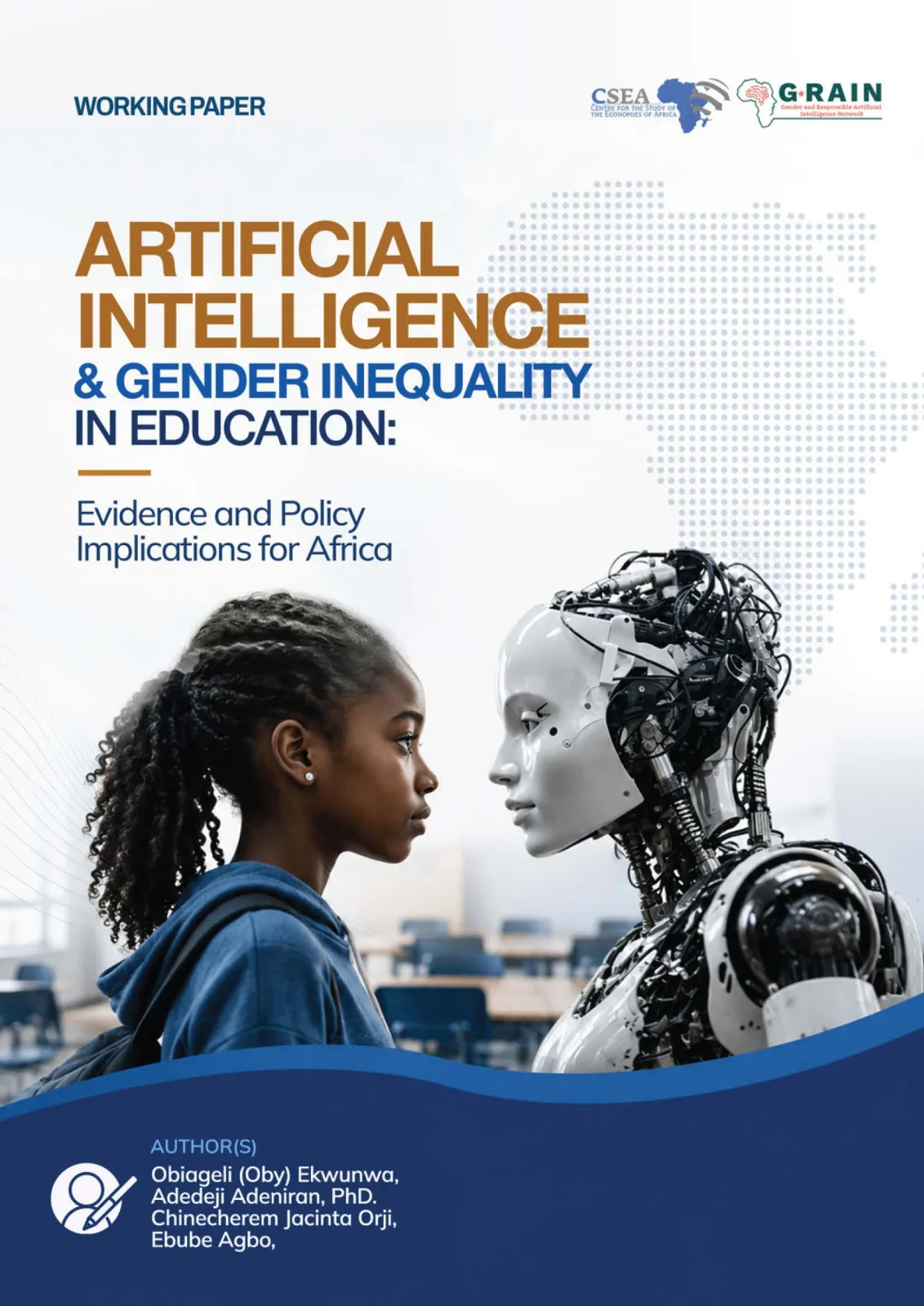
Recent evidence indicates that the emergence of Artificial Intelligence (AI) is rapidly transforming education. However, evidence on the effectiveness of AI interventions in addressing gender inequality in education remains limited. In this regard, this study conducts a Systematic Literature Review on the role of AI in addressing gender inequality in education and draws implications for Africa. This study applies the PRISMA systematic review approach and synthesises evidence from peer-reviewed articles obtained from Scopus, Web of Science, and Google Scholar for the period 2015–2025. The review centred around themes: STEM and non-STEM fields; inclusive education for marginalised learners; algorithmic bias and equity concerns; and attitudes, confidence, and digital skills. The findings indicate that the adoption of AI can be a potent instrument for reducing gender gaps and expanding access to education, particularly for girls and women with disabilities. However, the review also suggests that the scalability of AI potentials has remained a significant challenge in Africa due to inadequate technological infrastructure and ingrained gender norms that often restrict its equitable implementation. One of the implications of these findings for Africa is that it points out that the implementation of ethical and responsible AI in the education sector by prioritising gender-sensitive design and infrastructure investment can be a potent tool for enhancing female participation in AI-enabled learning environments on the continent. In addition, this study contributes to the literature by providing a structured synthesis of global evidence and highlighting the contextual constraints that shape AI effectiveness in Africa.
Free Trade Agreements (FTAs), such as the African Continental Free Trade Area (AfCFTA), can significantly influence biodiversity conservation based on their design and implementation. While AfCFTA may encourage countries to strengthen environmental regulations in line with international agreements like the Convention on Biological Diversity (CBD) and CITES, there are concerns that economic goals might overshadow ecological considerations. This could lead to industrial growth in agriculture and mining, risking deforestation, soil erosion, and water pollution. Using a combination of qualitative and quantitative methods, this study employs the Energy-Environment Integrated CGE (EEICGE) Model to analyze AfCFTA’s impacts on Africa's biodiversity. Simulation results for Nigeria indicate a rise in fossil fuel demand and carbon emissions. Stakeholder insights reveal that increased trade may drive intensified land use, contributing to deforestation and biodiversity loss. The study underscores that the impact of AfCFTA on biodiversity is contingent on specific provisions, enforcement capacities, and implementation contexts. To ensure FTAs support sustainable development, strategic measures are vital, including robust environmental regulation enforcement, local community engagement, and investment in renewable energy to meet rising energy needs while adhering to global commitments like the Paris Agreement.
AUTHORS: Augustine Iraoya, Chukwuka Onyekwena, David Okorie, Adedeji Adeniran
This paper was first published HERE
This paper examines the relationship between social assistance, violent conflict, and intersecting crises, and considers how social assistance can help offset erosive forms of coping that could otherwise drive poverty and food insecurity. To investigate these issues, the study draws on newly collected household data covering 1,000 survey respondents in 2023 from the Konduga and Maiduguri Municipal Council local government areas in Borno, Nigeria. Borno has been an epicentre for violence over the past 15 years, and has experienced a range of intersecting crises.
Study findings indicate that 43 per cent of households experienced disruptions to income or agriculture, or asset loss, either due to conflict, flooding, or drought. Of these households, 41 per cent reported that more than half of their income source was lost. Despite the negative effects of crises, only 1 in 10 households received social assistance in the year preceding the survey, mainly through non-governmental organisations. This indicates that social assistance is simply not getting through to the people who need it. Perhaps as a result, households are increasingly drawing on negative and even erosive forms of coping – for example, by being less able to save, less able to make investments, and increasing reliance on loans that together could drive downward mobility. The paper concludes with broad-brush implications for social assistance programmes to become more effective amidst violence and climate-related disasters
Africa’s largest economy has found itself in an increasingly vulnerable financial position due to several shocks in the past decade. It relied on private creditors to compensate for revenue shortfalls in 2016 and 2017 after the collapse of commodity prices. The COVID-19 pandemic induced more borrowing, this time from multilateral sources. These events have led to the highest external debt levels in Nigeria since 2004.
Increased debt levels clogged financing for key SDG outcomes relating to social welfare sectors more broadly and gender equality and the environment in particular. This paper explored the need for, viability of, and impacts of debt swaps in Nigeria. It focused on two sources of debt that are mostly likely to be involved in a debt swap: Paris Club ODA debt and underperforming private sector debt. These two sources together comprise a sum of more than $3.7 billion whose exchange could free up resources to fund development priorities for facilitators of the debt swap. If the entirety of the eligible debt were to be swapped, it would create an average of nearly $300 million of budgetary resources (per year) for the next six years. Beyond funding development projects, remaining funds could decrease the debt burden, provided they do not beget additional borrowing. The paper also traced the experiences of five countries participating in debt-for-nature swaps.
This Paper was first published by RED SUR as part of the Working Paper of the Project “Promoting a pandemic recovery: evidence to support managing the growing debt crisis” (IDRC - Red Sur N° 109742-001)
Systematic, quantitative evidence on education system coherence is limited. Prior research has indicated alignment of instructional components, such as curriculum standards, assessments, and teachers’ instruction, is important for children’s learning. This study uses the Surveys of Enacted Curriculum methodology to investigate alignment of instructional components in Nigeria's primary education system. The study analyzes curriculum standards, national exams, and classroom instructional content for mathematics and English language across all six primary-level grades. We find that key foundational mathematics and English language skills are covered by all three components, with some notable omissions on the end-of-cycle English language exams. All three components give high emphasis to the low cognitive demand processes of ‘memorize’ ‘perform’, and ‘demonstrate’, and give very low emphasis to the more demanding cognitive processes of ‘analyze’ and ‘apply to non-routine situations’. Both the curriculum standards and classroom instruction depict a slow pace of content progression across grades, manifested through broad but shallow content coverage. The high alignment suggests the potential for a well-functioning education system, however, low student performance in mathematics and English language exams suggest otherwise. The findings suggest the Nigerian primary education system may be operating in a low-achieving equilibrium in which the system is aligned for low levels of cognitive demand and student mastery.
This Working paper was first published here .
Authors: Adedeji Adeniran, Sixtus Onyekwere, Anthony Okon, Julius Atuhurra, Rastee Chaudhry and Michelle Kaffenberger