


Journal Articles and Book Chapters

  • Home
  • Journal Articles and Book Chapters

Does rising inflation affect the tourism industry? Evidence from Nigeria

The rising spate of inflation in Nigeria has become worrisome in recent years, considering its implications on the quest for tourism development in the country. This study, therefore, empirically evaluates the effect of inflation on the Nigerian tourism industry. Two tourism indicators (tourism arrivals and tourism receipt) are employed in this study for robustness and quarterly data on relevant variables for the period between 1995Q1 and 2020Q4 were analysed using different econometric approaches. The results of all the estimation methods unanimously revealed a trade-off between inflation and the two tourism indicators, signalling that inflation dissuades international tourist arrival and lower tourism revenue in Nigeria. Hence, the Nigerian monetary authority must ensure price stability by keeping the inflation rate at a desirable level in a bid to foster tourism development in the country.

READ MORE

Authors: Isiaka Raifu Akande and Joshua Adeyemi Afolabi
Read More

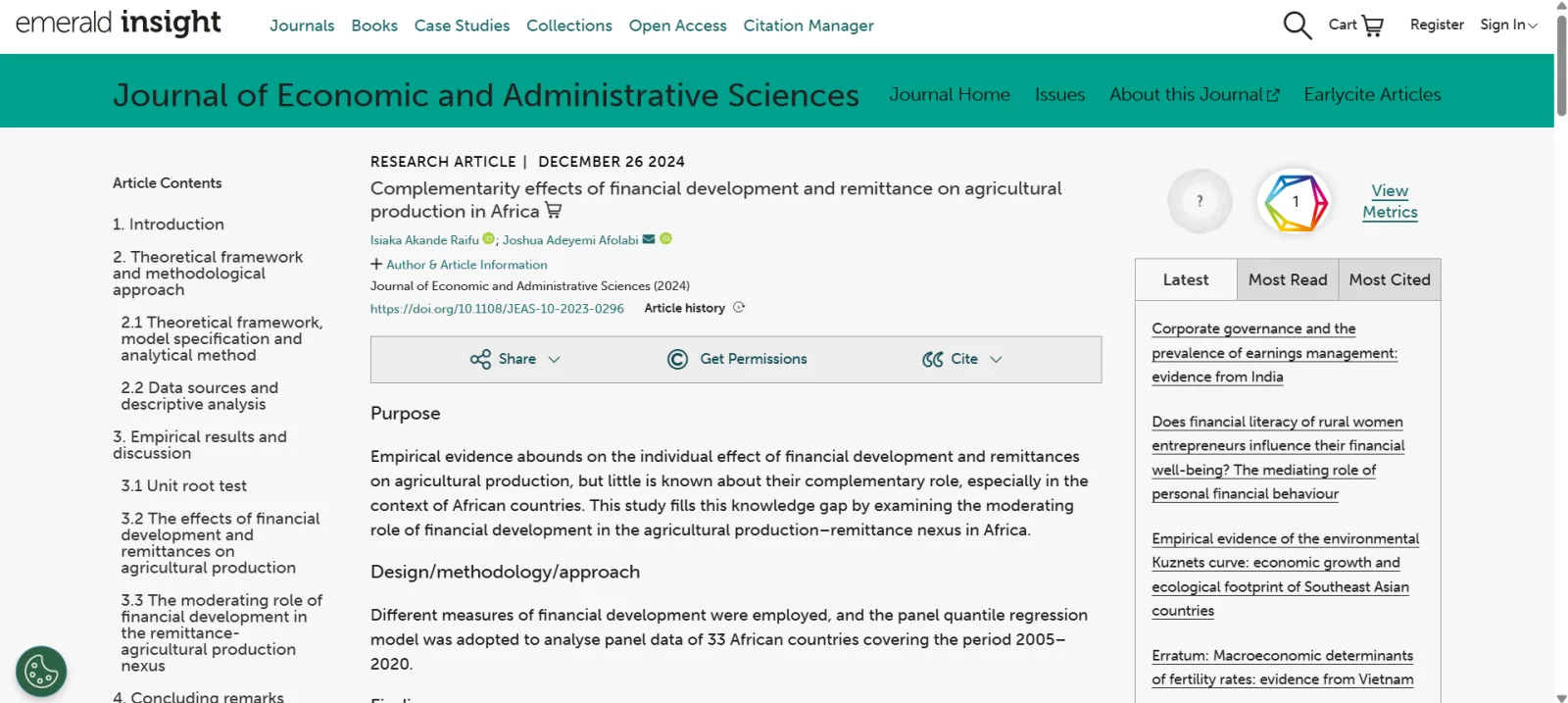
Complementarity effects of financial development and remittance on agricultural production in Africa

The results indicate that the effects of financial development on agricultural production vary across quantiles, and the dynamics of agricultural production are sensitive to the choice of financial development indicator. Nevertheless, financial development and remittances are highly indispensable for improved agricultural production in Africa, as financial development complements the positive effect of remittances on agricultural production.

Read More

Read More

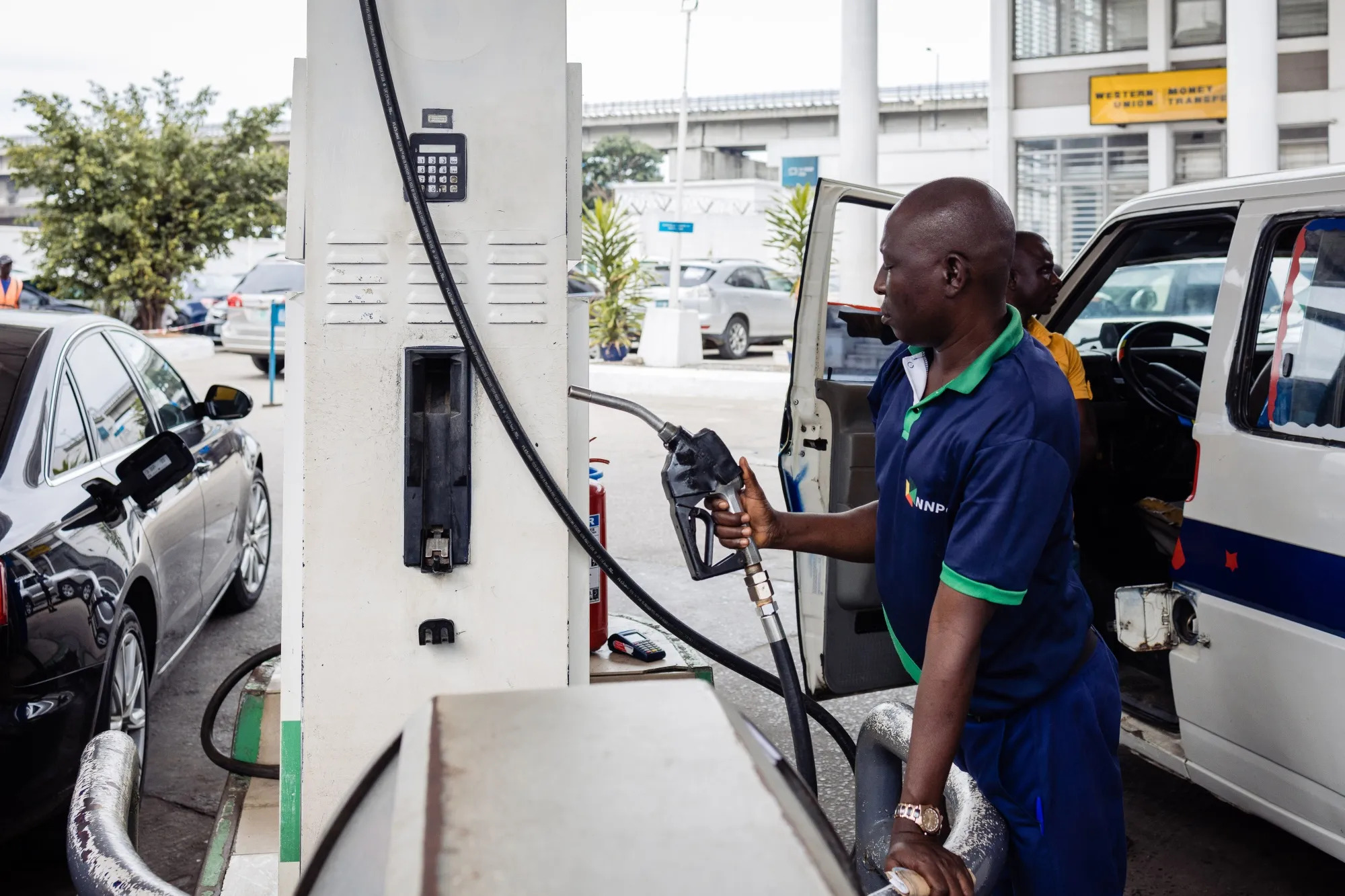
Simulating the Inflationary Effects of Fuel Subsidy Removal in Nigeria: Evidence From a Novel Approach

This study simulates the effect of fuel subsidy removal on different categories of inflation in Nigeria using the novel dynamic simulated autoregressive distributed lag framework. Findings revealed heterogeneity in the inflationary effect of an increase in premium motor spirit price across locations, and that the recent fuel subsidy removal in Nigeria will have long-lasting negative inflationary effects.

READ MORE

Authors: Isiaka Akande Raifu, Joshua Adeyemi Afolabi
 

Read More

Does Access to Clean Fuel and Technology Improve Health Outcomes? A Comparative Analysis of Africa and Asia

This study examines the effect of access to clean fuel and technology on health outcomes, drawing a comparison between Africa and Asia over the period 2000–2021. Using Generalised Least Squares, our findings revealed that access to clean fuel and technology improves health outcomes in both regions, suggesting that having access to clean fuel and technology is indispensable to improving health outcomes in Africa and Asia. Thus, governments in the two regions should prioritise and invest in technology that provides access to clean energy.

READ MORE


Authors: Isiaka Raifu Akande and Nantap Rejoice Ditep

Read More

Towards Economic Resilience in Sub-Saharan Africa: The Role of Institutional Quality and Human Capital Development

A viable economy's hallmark is its ability to generate positive growth rates and its capacity to sustain such growth, especially during a crisis. Economic crises have the potential to induce uncertainty, reverse pre-crisis economic gains and force preexisting challenges to reemerge, necessitating actions on building economic resilience. Given the fragility of most countries in Sub-Saharan Africa (SSA), the current paper evaluates the role of institutional quality (INSQ) and human capital development in boosting economic resilience in SSA. The sampled countries were classified into fragile and resilient countries. Annual data spanning 2000–2021 was obtained and analyzed using the Bias-Corrected Method of Moments (BCMM) estimation method, which can adequately account for cross-sectional dependence, endogeneity, and heterogeneity in the sample.

READ MORE

Authors: Joshua Adeyemi Afolabi, Isiaka Akande Raifu

Read More