


Journal Articles and Book Chapters

  • Home
  • Journal Articles and Book Chapters

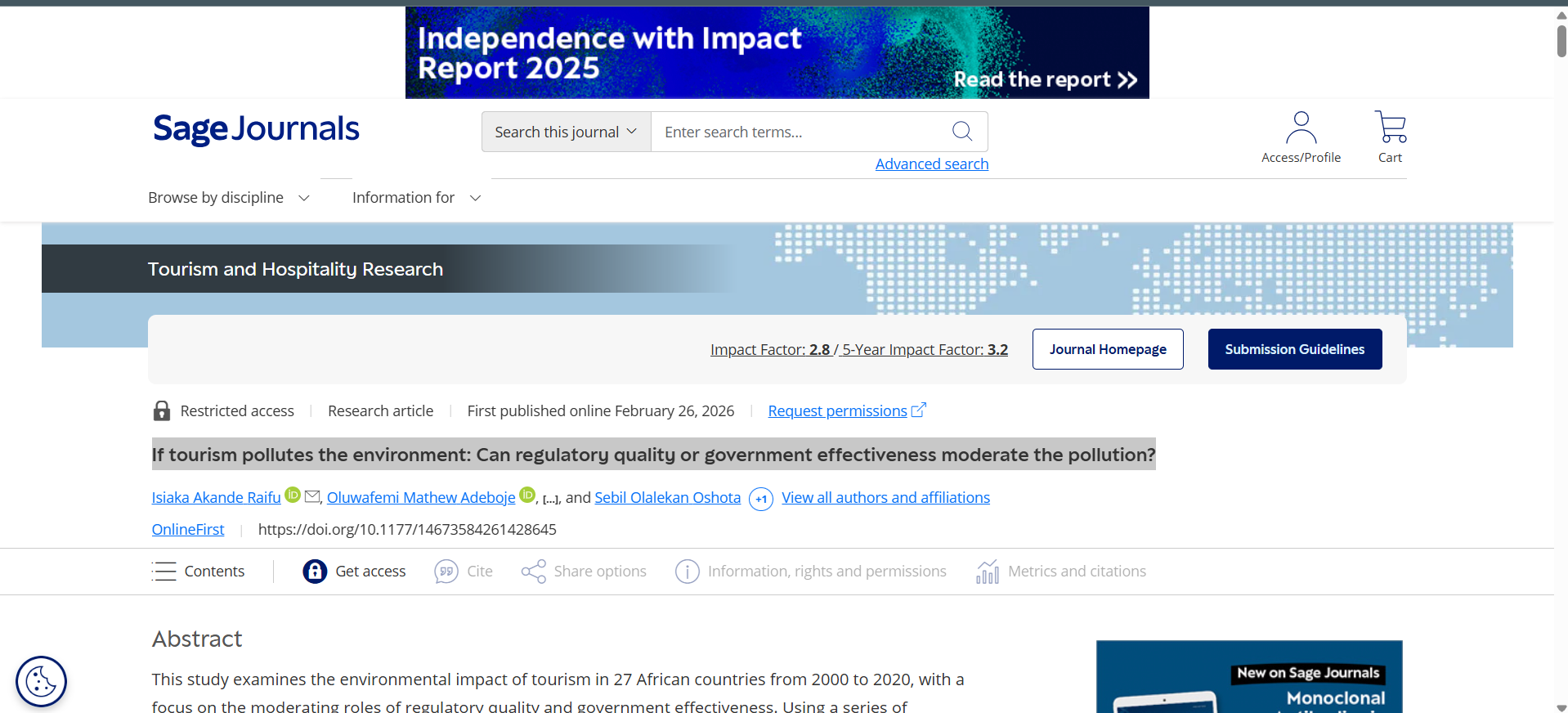
If tourism pollutes the environment: Can regulatory quality or government effectiveness moderate the pollution?

This study examines the environmental impact of tourism in 27 African countries from 2000 to 2020, with a focus on the moderating roles of regulatory quality and government effectiveness. Using a series of estimation methods (FMOLS, CCR, FGLS, SGMM), the study shows that increased tourist arrivals significantly heighten environmental pollution, validating the early-stage Environmental Kuznets Curve (EKC) hypothesis. Although regulatory quality and government effectiveness independently reduce emissions, their interaction with tourism remains positive and significant, indicating that existing institutions cannot offset tourism’s environmental consequences. This suggests that, despite some institutional strength, Africa’s governance capacity is insufficient to ensure tourism-led growth is environmentally sustainable. To address this gap, the study recommends strengthening regulatory institutions, enhancing enforcement capacity, expanding renewable energy use, and integrating environmental accountability into tourism policies. Governance reforms that prioritise implementation, coordination, and policy coherence are crucial to ensuring that tourism contributes to economic development without accelerating environmental degradation.
Read more

Read More

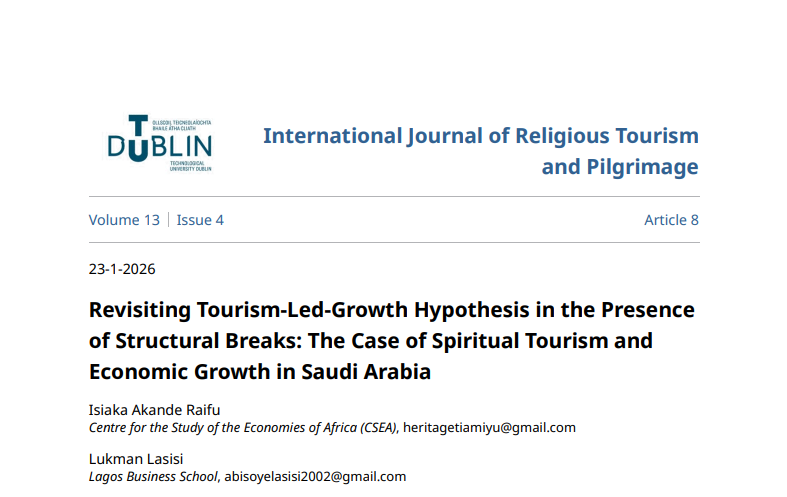
Revisiting Tourism-Led-Growth Hypothesis in the Presence of Structural Breaks: The Case of Spiritual Tourism and Economic Growth in Saudi Arabia

The study explores the Tourism-led-growth Hypothesis (TLGH) with a focus on spiritual tourism and economic growth in Saudi Arabia. Using the Generalised Method of Moments (GMM) for 28 years of annual data, we evaluated the impact of religious tourism on economic growth in the presence of structural breaks. Our analysis yielded promising results; thus, we make 4 important contributions to the literature. First, we establish the presence of a positive relationship between spiritual tourism and economic growth across all our models. Second, we discover that domestic pilgrimage in Saudi Arabia is a modest contributor to economic growth compared with international pilgrimage. Third, we demonstrate the importance of a structural break in modelling the relationship between the two major variables, spiritual tourism and economic growth. Finally, we show that capital formation in Saudi Arabia’s economy is largely from foreign pilgrims. The findings of our study have remarkable significance for both investors and policy makers within and outside Saudi Arabia.

Read more

Read More

Examining structural stability and time-varying causality between exports and economic growth in China amidst shock

Can the Chinese economy still be driven by exports in the face of global shocks? This research question is explored in this brief study. Economists and public policy analysts widely asserted that China’s economic growth and development were built on a strong foundation of the export-oriented manufacturing sector (Johnston, 2024). Precisely, China embarked on the mission of export-led growth in the 1980s, marked by a series of economic reforms such as trade liberalisation (particularly joining the World Trade Organization [WTO] in 2001), the reindustrialisation process around 2004 and the processing of export goods (Yao, 2014). However, concerns have emerged about whether the Chinese economy can continue to rely on exports as its primary driver in the years ahead. Roubini (2024) argues that China’s export-led growth model has broken down. He provides a reason for this development. He notes that after three decades of robust economic expansion, during which the economy grew at an average annual rate of 10%, China’s growth has slowed significantly. Currently, the growth rate hovers around 5% and the International Monetary Fund projects that it could decline further to approximately 3.4% by 2028 [1]. Roubini attributes this economic outlook to structural, rather than cyclical problems. These include an ageing population, a collapsed real estate bubble, massive overhangs of private and public debt and a marked shift away from market-oriented reforms back to state capitalism.

Read More

Read More

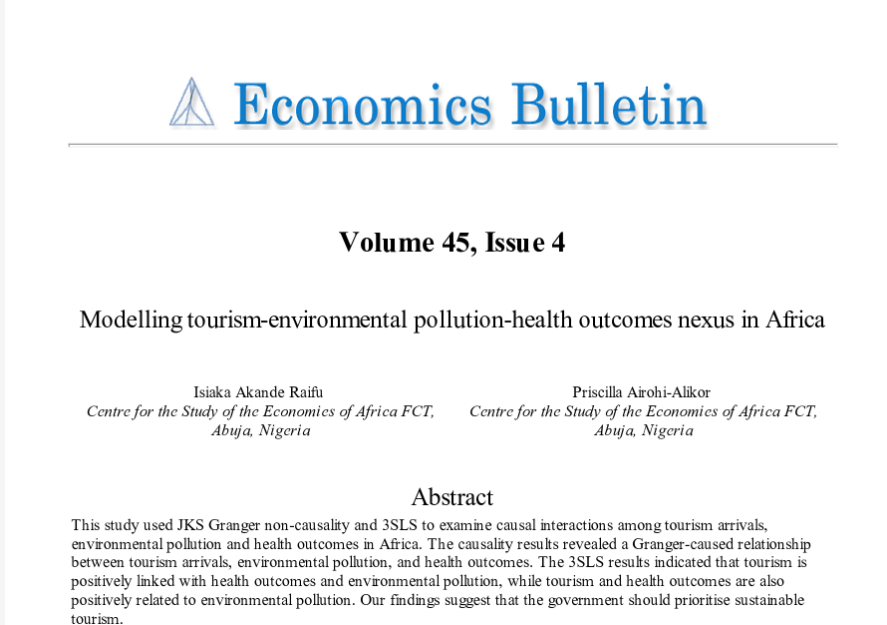
Modelling Tourism-Environmental Pollution-Health Outcomes Nexus in Africa.

This study used JKS Granger non-causality and 3SLS to examine causal interactions among tourism arrivals, environmental pollution and health outcomes in Africa. The causality results revealed a Granger-caused relationship between tourism arrivals, environmental pollution, and health outcomes. The 3SLS results indicated that tourism is positively linked with health outcomes and environmental pollution, while tourism and health outcomes are also positively related to environmental pollution. Our findings suggest that the government should prioritise sustainable tourism.  

Read more

Read More

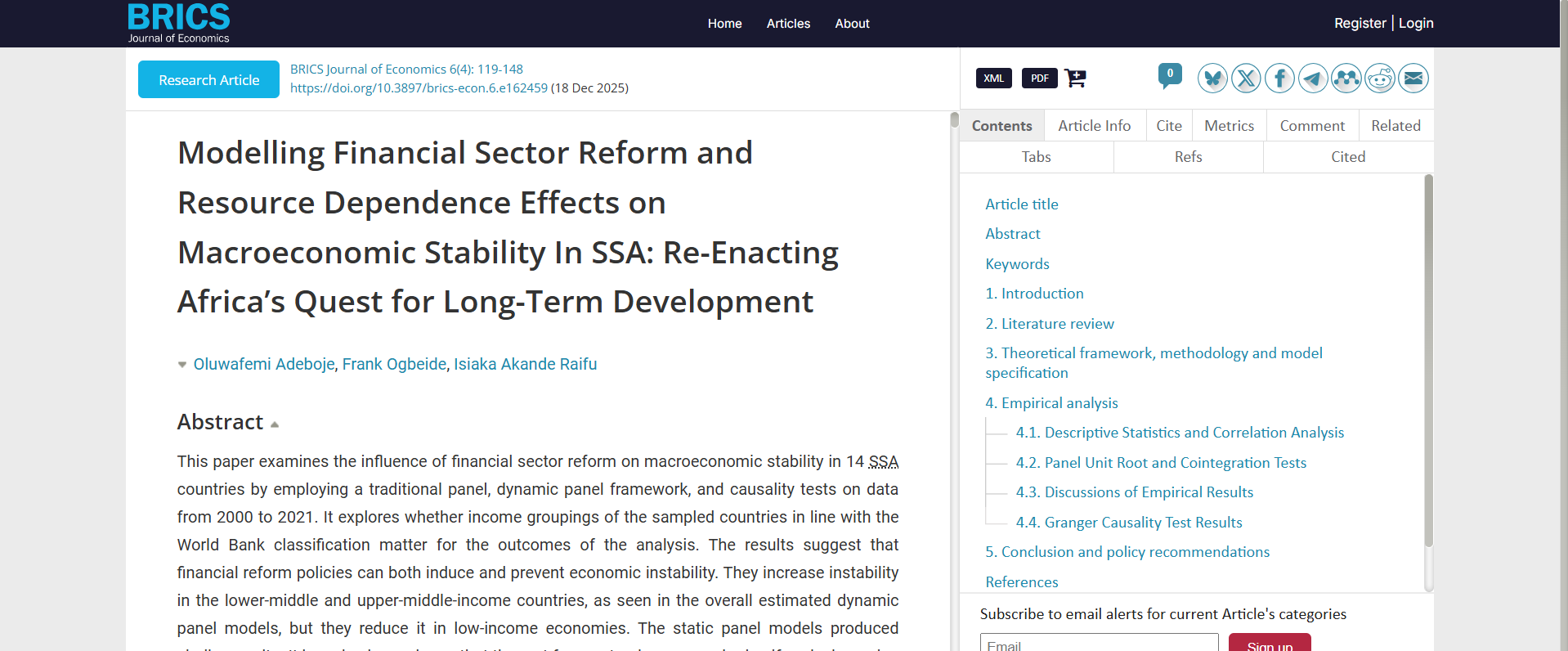
Modelling Financial Sector Reform and Resource Dependence Effects on Macroeconomic Stability In SSA: Re-Enacting Africa’s Quest for Long-Term Development

This paper examines the influence of financial sector reform on macroeconomic stability in 14 SSA countries by employing a traditional panel, dynamic panel framework, and causality tests on data from 2000 to 2021. It explores whether income groupings of the sampled countries in line with the World Bank classification matter for the outcomes of the analysis. The results suggest that financial reform policies can both induce and prevent economic instability. They increase instability in the lower-middle and upper-middle-income countries, as seen in the overall estimated dynamic panel models, but they reduce it in low-income economies. The static panel models produced similar results. It has also been shown that the rent from natural resources had uniformly damaging effects on the macroeconomic stability of all income groups in SSA, effectively confirming the “resource curse” thesis. Yet, the findings of the panel as a whole contradicted this, suggesting that revenue from natural resources can effectively play a role in stabilizing macroeconomic conditions. The results also suggest the existence of what can be called “a human capital-misery trap”, in which higher human capital development can lead to macroeconomic instability. Inflation was found to have a detrimental effect, and the impact of government interventions appeared to be mixed. This paper emphasizes the need for robust financial reforms and comprehensive policy measures in Sub-Saharan Africa (SSA), aiming to enhance the effectiveness, competitiveness, and stability of the financial sector and the broader economic landscape, which will require prudent management of natural resources.

Read More

Read More