Journal Articles and Book Chapters

  • Home
  • Journal Articles and Book Chapters

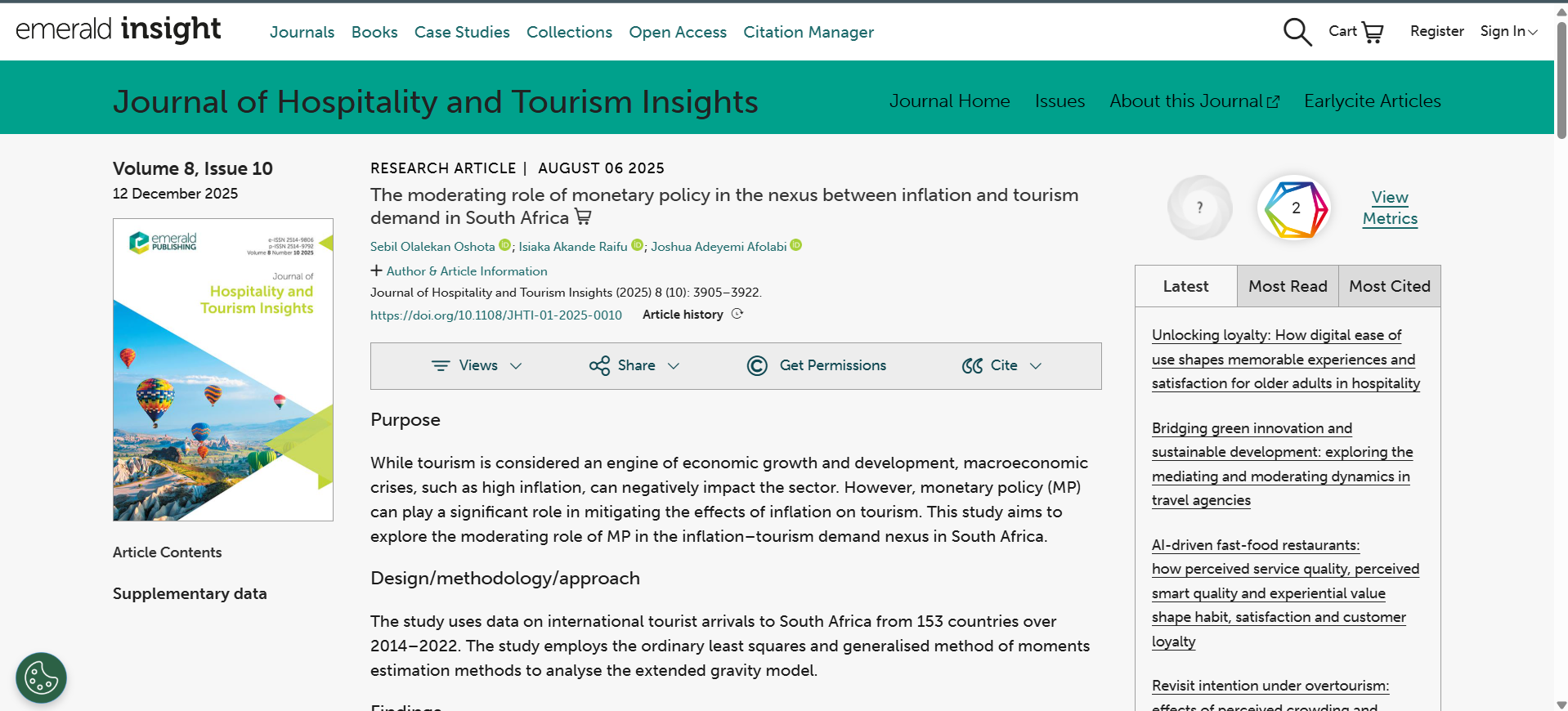
The moderating role of monetary policy in the nexus between inflation and tourism demand in South Africa

While tourism is considered an engine of economic growth and development, macroeconomic crises, such as high inflation, can negatively impact the sector. However, monetary policy (MP) can play a significant role in mitigating the effects of inflation on tourism. This study aims to explore the moderating role of MP in the inflation–tourism demand nexus in South Africa.

Read More

Read More

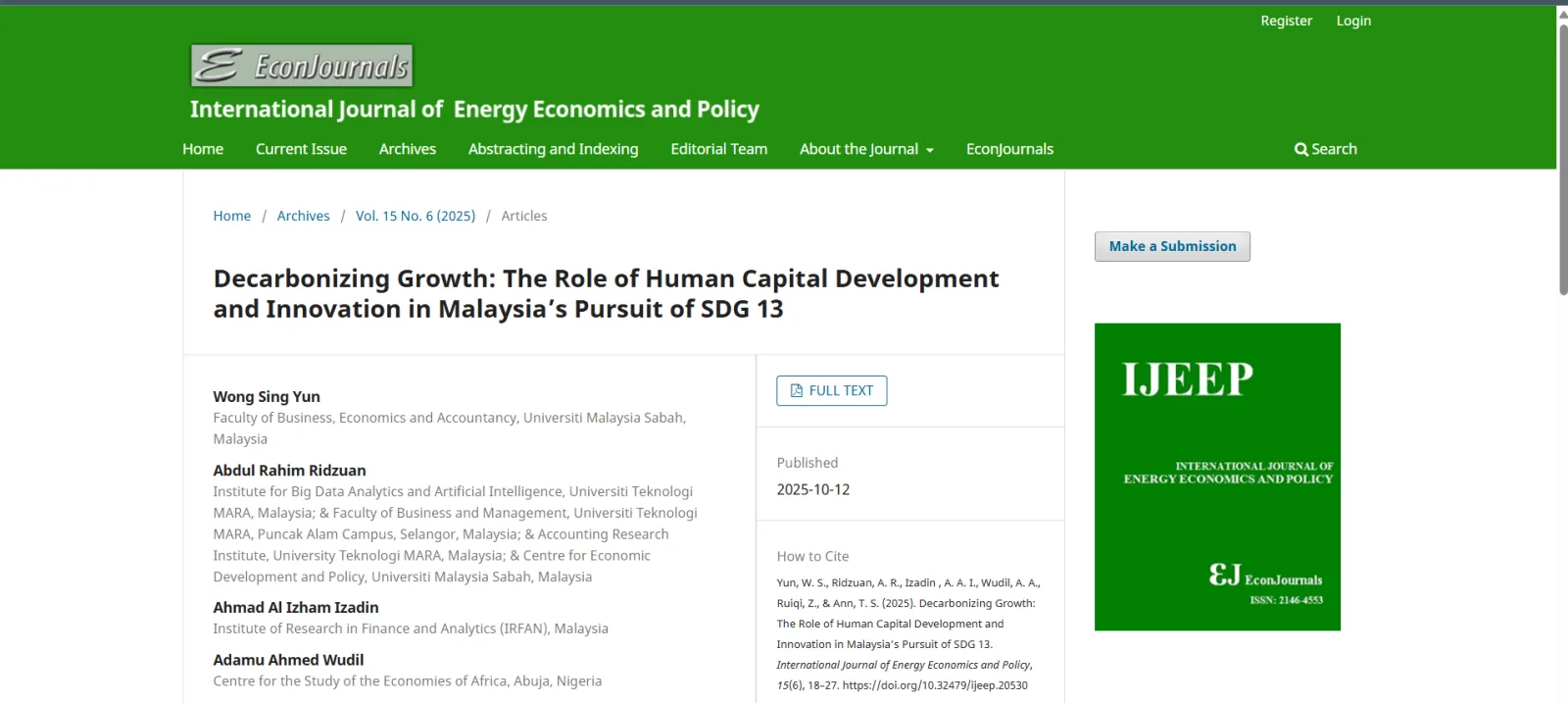
Decarbonizing Growth: The Role of Human Capital Development and Innovation in Malaysia’s Pursuit of SDG 13

This study investigates the impact of human capital development and technological innovation on environmental sustainability in Malaysia, as part of the Malaysian commitment to Sustainable Development Goal 13 (Climate Action). Using Autoregressive Distributed Lag (ARDL) model and time series data covering the period 1990-2022, the analysis explores the dynamic relationship between CO2 emissions and major macroeconomic variables, namely economic growth, energy consumption, technological innovation, trade openness, foreign direct investment (FDI), quality of governance, education, and GINI coefficient. The empirical findings reveals that technological innovation and human capital development significantly contribute to long-run decline in CO2 emission, hence emphasis their role in ensuring a sustainable low-carbon economy. On the other hand, FDI correlates with higher emissions, which gives relevance to pollution haven hypothesis in the Malaysian case. The study emphasis the need to invest in green technology, incorporate sustainability in the education system and tightening environmental standards in the foreign investments. Such policy steps are necessary to ensure that economic progress is no longer linked to environmental degradation and accelerate Malaysia’s transition towards a climate-resilient future.

Read More

Read More

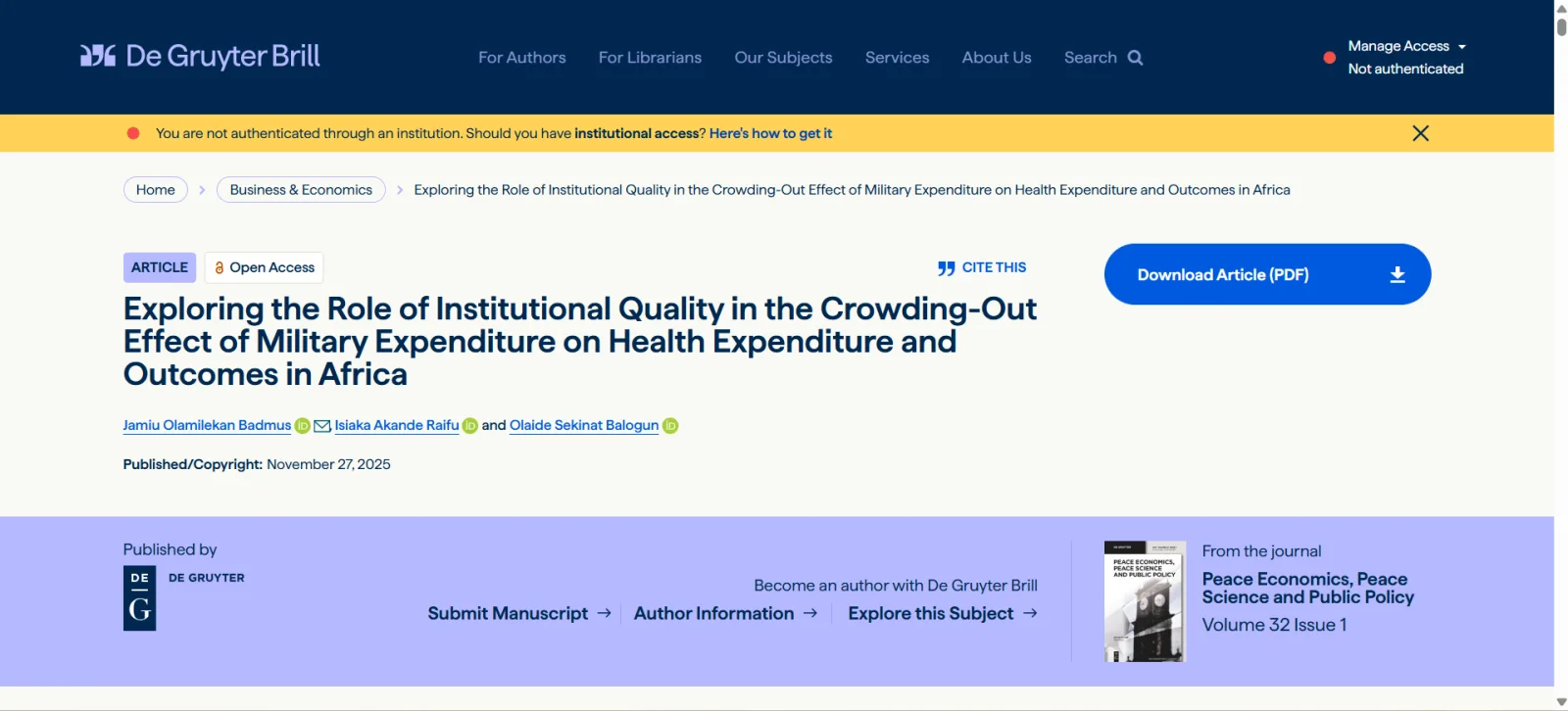
Exploring the Role of Institutional Quality in the Crowding-Out Effect of Military Expenditure on Health Expenditure and Outcomes in Africa

This study revisits the long-standing debate on the guns-versus-butter phenomenon, that spending on military activity crowds out non-military expenditure. By focusing on Africa, we conjecture the crowding-out effect of military expenditure on health expenditure beyond government health expenditure, but also private and out-of-pocket health expenditure, and health outcomes. The empirical analysis based on the dynamic two-step system generalized method of moments reveals that omitting institutional quality measures biases the estimated crowding-out effects of military expenditure. After the inclusion, the results indicate that a 10 % increase in military expenditure leads to a 0.40 % decline in government health expenditure, accompanied by 0.01 % and 0.30 % increases in private and out-of-pocket health expenditure, respectively. Regarding health outcomes, the same increase in military expenditure results in a 0.20 % rise in maternal mortality, while infant mortality and life expectancy decline by 0.09 % and 0.01 %, respectively. Further analysis reveals that including the interaction term of military expenditure and institutional quality only reverses the crowding-out effect on government health expenditure and not on private and out-of-pocket health expenditure. For health outcomes, the favorable effect of the interaction term is only evident in reducing infant and maternal mortality rates. We offer policy recommendations to improve fiscal spending on the health sector in Africa as a paramount measure to improve human capital development and provide areas for further empirical contributions.

Read More

Read More

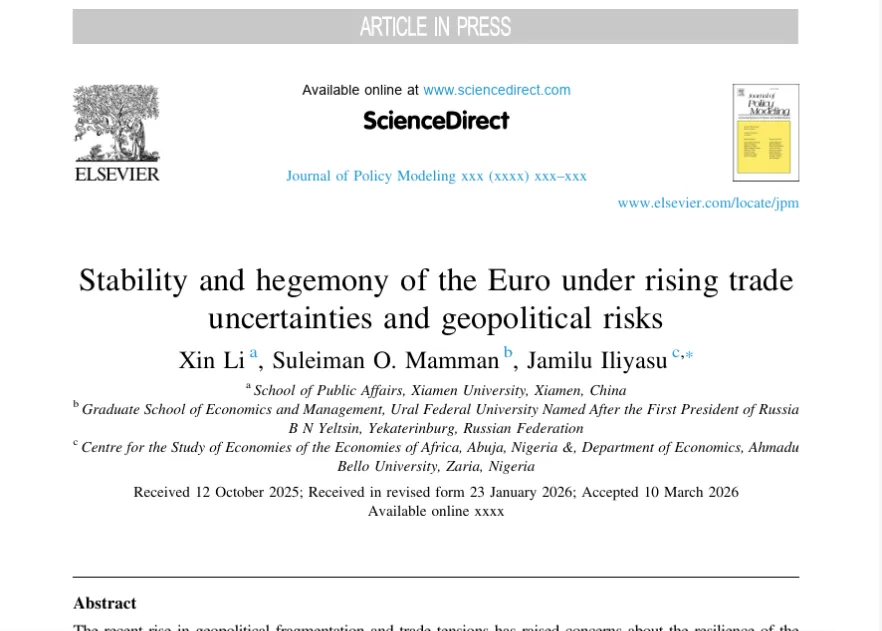
Stability and hegemony of the Euro under rising trade uncertainties and geopolitical risks

The recent rise in geopolitical fragmentation and trade tensions has raised concerns about the resilience of the international role of the euro. Thus, this study examines how geopolitical risk shocks associated with U.S.–China trade tensions and the Russian–Ukrainian conflict influence the international hegemony of the euro as well as the institutional foundations of monetary unification in the Eurozone. The results from machine learning techniques and Bayesian model averaging show that these geopolitical tensions have weakened the international position of the euro. In addition, this study observes that the concurrent presence of the trade war and the persistence of the conflict amplifies these adverse effects on the euro. However, the findings also show that inertia in the historical use of the euro appears to mitigate the adverse impact of these shocks. Further analysis also indicates that Euro Area public debt levels and the legacy of the sovereign debt crisis act as structural constraints to the resilience of the eurozone. This study suggests that strengthening fiscal sustainability, deepening monetary and financial integration, and improving policy coordination among Eurozone members can be potent tools for enhancing the stability and international role of the euro under rising geopolitical uncertainty

This Article was written by Jamilu Iliyasu

Read More

Read More

On the Nexus Between Terrorism and Tourism in Nigeria: What Role Does Institutional Quality Play?

It has been established that terrorism has a catastrophic effect on tourism. How does the quality of institutions in a terrorist-infected country like Nigeria moderate the catastrophic impact of terrorism on tourism? The purpose of this study, therefore, is to investigate the moderating role of institutional quality in the relationship between terrorism and tourism in Nigeria. The study used Dynamic Ordinary Least Squares (DOLS) and Canonical Cointegration Regression for main estimation and robustness, respectively. Quarterly data from 1995 to 2019 was used for the analysis. The results showed that tourist arrivals and tourism receipts declined as the terrorism fatality increased. Precisely, an increase in terrorism fatality by 1% leads to a reduction in tourist arrivals and tourism receipts by 0.09% and 0.52%, respectively. The findings remain consistent or robust to the alternative estimation method – Canonical Cointegration Regression (CCR). Our results further show that institutional quality increases both tourist arrivals and tourism receipts by 0.67% and 0.16%, respectively. On the net effect of institutional quality on tourism, we discover that institutional quality attenuates or mitigates the detrimental impact of terrorism on tourist arrivals and tourism receipts. As a policy recommendation, the study suggests the government should strengthen domestic institutions to prevent terrorist attacks and attract more tourists to boost tourist revenues.

Read More